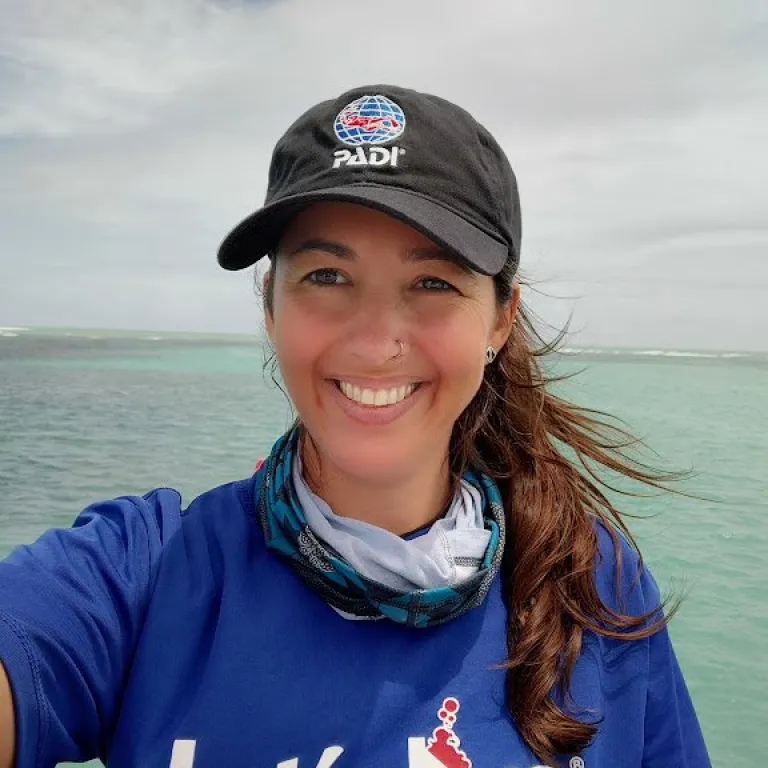
Fernanda, you have a rare combination of high-level corporate management experience in Brazil and deep dive education expertise in South America. How did that dual background shape the way you approach excellence in diving and the day-to-day management of Roatan Divers in West End?
Having a business degree, spending 10 years working for a large company in São Paulo, and owning my own dive shop in Maceió, Brazil, have made a huge difference in my diving career.
As a manager, I am responsible for every aspect of the operation. My job goes far beyond diving: I manage people, develop business strategies, set pricing, oversee equipment inventory, drive sales and marketing, coordinate maintenance, and, perhaps most importantly, solve problems every day.
My university gave me a strong foundation in business, but it was my experience in the corporate world and later as a business owner that taught me how to put that knowledge into practice.
Not every dive instructor has this business background, and I truly believe it makes a significant difference. Understanding both diving and business opens the door to management positions, helps you grow professionally, and allows you to contribute to the long-term success of a dive center.
From your perspective as both General Manager and Course Director, what are the concrete elements that make Roatán stand out as a world-class dive destination, and how do you translate those natural advantages into a consistently exceptional experience for divers on your boats and at your center?
The island of Roatan offers exceptional diving conditions. The ocean is typically calm, visibility is excellent, and the reef is stunning, with healthy corals and an incredible diversity of dive sites. Divers can explore deep walls, shallow reefs, swim-throughs, wrecks, and much more, all within a short boat ride.
Roatán also has an international airport with numerous direct flights from the United States, making it easy for divers to travel here. These advantages certainly help attract visitors, but in the end, it is the quality of our service that truly makes the difference.
We are incredibly proud of our team. Our instructors are highly knowledgeable, passionate about diving, and committed to providing every guest with an outstanding experience. We believe that exceptional customer service comes from paying attention to every detail, no matter how small.
If you read our reviews on Google or TripAdvisor, you'll find that many of our guests highlight the professionalism of our staff and the quality of the experience we provide. That commitment to excellence is what makes Roatan Divers unique.
Roatan Divers is known for boutique diving with small groups and a strong training culture. Can you walk us through how you design and enforce operational standards – from logistics and scheduling to instructor allocation and gear management – to maintain that 1-to-6 ratio without compromising safety, profitability, or guest experience?
We have developed detailed Standard Operating Procedures (SOPs) to ensure that every detail matters. From the way we respond to emails, welcome guests at the dive shop, and set up equipment on the boat, to the dive briefing, gear rinsing, and post-dive service, every step is carefully documented. We train our team to follow these standards consistently so that every guest enjoys a true boutique diving experience.
Keeping our dive groups small is another key part of our philosophy. Small groups make our operation both safer and more enjoyable. Our instructors have the time to guide each diver, point out fascinating marine life, and respond quickly to any situation that may arise underwater. Instead of simply leading a group from one point to another, they can provide personalized attention and create memorable experiences.
This commitment to quality is why so many of our guests return year after year, bring their friends and family, and enthusiastically recommend Roatan Divers to others.
You led logistics and operations in a global corporation before founding your own dive center. What are some specific management or process tools from the corporate world that you’ve successfully adapted to running a PADI 5-Star IDC Eco and Tec Center in Roatán, and where did you have to deliberately do the opposite of corporate logic to protect the quality of the diving?
Throughout my career, I have had the opportunity to work with a wide variety of software, including CRM systems, booking platforms, design tools, and other business management applications. I have also developed and implemented many operational controls and processes to improve efficiency and organization.
This experience has made managing a dive shop much more effective and allows me to focus on both the big picture and the day-to-day operations. I enjoy using technology and am always looking for new tools that can simplify workflows, improve communication, and make daily tasks more efficient.
I believe that embracing technology is essential for running a successful dive operation. The right systems not only save time but also create a better experience for both the team and our customers.
As a PADI Eco Center operating on one of the planet’s most famous reefs, how do you balance commercial growth – more boats, more courses, more guests – with strict environmental responsibility, and can you share a practical example of a decision where you chose reef protection over short-term revenue?
It would certainly be easier to operate with large dive groups, and in the short term, it could generate more revenue. However, it would also make it much harder to properly supervise divers. Without close guidance, divers are more likely to touch corals, damage marine life, or accidentally harm the reef. While larger groups may increase profits in the short term, they are not sustainable in the long run. Protecting the marine environment is one of our highest priorities, and keeping our groups small allows us to provide better supervision while minimizing our environmental impact.
This year, we also invested in replacing our boat engines with modern four-stroke engines instead of two-stroke models. Although they were nearly twice as expensive, they are significantly more fuel-efficient and produce fewer emissions, reducing our environmental footprint.
We also prioritize environmentally friendly products throughout our operation. For example, we choose eco-friendly cleaning products for our dive shop, even though they cost more than conventional alternatives. We believe these choices are an investment in the future of the reefs we depend on.
In addition, we have developed our own digital management system, which has allowed us to eliminate almost all printed paperwork. By moving our operations online, we have significantly reduced our paper consumption while making our processes more efficient and organized.
Looking ahead five to ten years, how do you see the standards of dive excellence in Roatán evolving – in terms of training, technology, technical diving, and sustainability – and what strategic moves are you making at Roatan Divers now to stay ahead of those changes?
Being environmentally responsible and protecting our oceans is one of our core values. As the diving industry continues to evolve, sustainable practices are becoming the standard rather than the exception, and we are proud to be part of that change.
One of the ways we demonstrate this commitment is by teaching all of our students in neutral buoyancy from the very beginning. Unlike the traditional approach of having students kneel on the bottom, we conduct our training while they remain neutrally buoyant. This helps students develop better diving skills while ensuring they do not damage corals or disturb marine life. It requires more patience, skill, and effort from our instructors, but we believe the benefits for both the diver and the environment are well worth it.
As a dive center that also trains Divemasters and PADI Instructors, we have the opportunity to create an even greater impact. We don't just teach professional-level divers, we teach future dive professionals how to train students using environmentally responsible techniques. In doing so, they carry these values into their own careers and pass them on to thousands of divers around the world. This is the legacy we want to leave for the diving industry and for the oceans we all depend on.
For divers and future dive professionals dreaming of coming to Roatán, what honest advice would you give them about choosing a dive center, building a meaningful career in diving, and contributing positively to the island’s community and marine ecosystem rather than just consuming the destination?
Your professional training is an investment in your future career, so don't make your decision based on price alone.
Take the time to compare what is included in each training package. Look at who will be teaching you, the experience of the Course Director, and the dive center's experience in training Divemasters and Instructors. Evaluate the facilities as well, including the boats, rental equipment, classrooms, and overall organization of the operation.
A high-quality training program will provide you with a strong foundation for your career. It will help you develop the confidence, knowledge, and practical skills needed to work with real students and become a successful dive professional.
I also encourage future professionals to choose dive centers that are genuinely committed to environmental sustainability. Eco-conscious dive shops invest significant time, effort, and resources into protecting coral reefs, marine life, and the ocean. By training with these centers, you'll not only become a better dive professional but also learn responsible practices that will help preserve the underwater world for future generations.
Remember, the skills, habits, and values you develop during your training will stay with you throughout your entire career. Choose a dive center that invests in your success, not just in certifying you!
Learn more: https://roatandivers.com